 Words
Words
Wordle
Six tries, five letters, one fresh word every day.
Opens on nytimes.com.
Need a nudge on today's board? Wordle Hint Today gives six folded clues and keeps the answer closed until you open it.
About this game
How Wordle plays
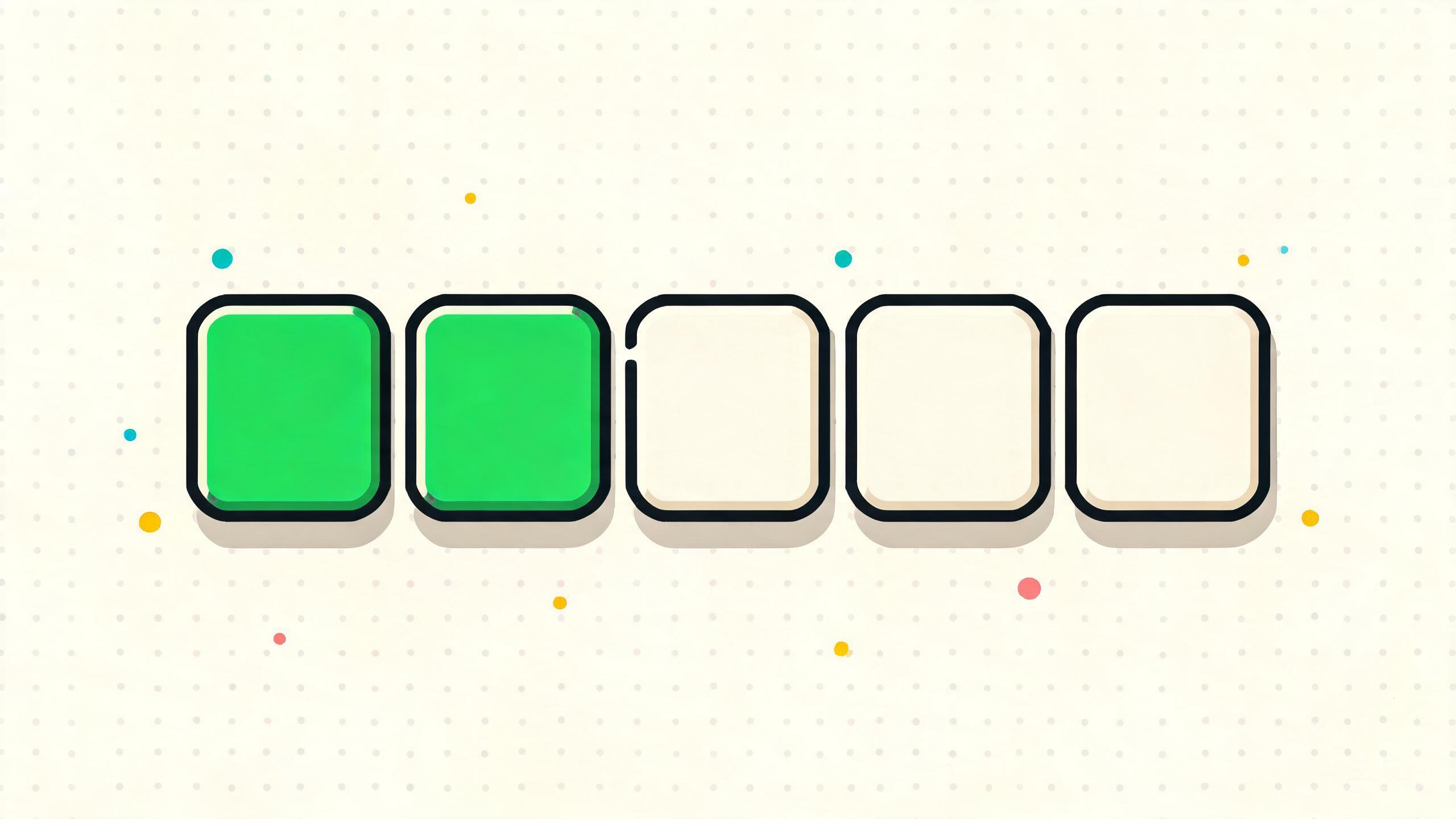
Wordle hides a five-letter word and gives you six attempts to find it. Green tiles confirm a letter in the right place, yellow tiles mark a letter that belongs elsewhere, and gray tiles remove it from your shortlist. One word is shared by every player each day.
Prefer a second letter grid? The Games like Wordle list ranks the closest daily alternatives by mechanic.
Rule breakdown
What green, yellow and grey actually mean
Wordle gives you six attempts at a five-letter answer. Every guess has to be a real five-letter word, and after each attempt the game colours each letter to tell you how close you are. The colours are the whole game: they are the only information you get, and reading them correctly is what turns a lucky guess into a planned solve.
Green means the letter is in the answer and in exactly the position you placed it. A green square is settled information; you should keep that letter where it is in later guesses.
Yellow means the letter appears in the answer, but not in the position you used. The letter is confirmed, the location is wrong, so a yellow square tells you to keep the letter and move it somewhere else.
Grey means the letter is not in the answer at all. Grey letters are also marked on the on-screen keyboard, which is why experienced players check the keyboard before planning the next row instead of re-reading every previous guess.
The three states are independent. A yellow letter can turn green on a later guess once you move it, a green letter never becomes yellow, and a grey letter stays grey. That makes each guess a mix of confirmation and elimination rather than a simple hit or miss.
A worked example, not a real answer
Take a hypothetical answer of CLOUD. It is an ordinary word used here to show the feedback, not a puzzle from a particular day. Suppose your first guess is AUDIO. The answer contains O, U and D, but none of them sits where AUDIO puts them, while A and I do not appear at all. The row comes back grey, yellow, yellow, grey, yellow.
From that single row you know three letters are present and two are absent, and you know none of the three is in its current position. A strong second guess should place those letters in new positions or test the remaining consonants, rather than repeating A or I. One row has turned a 26-letter search into a much smaller set of candidates.
Opening strategy
Choosing a first word that keeps working
A good opening guess does two jobs: it tests letters you are likely to need, and it leaves you with a useful second guess. Vowels are the main bottleneck. Knowing which vowels appear, and which do not, removes large parts of the possible answer space before you have placed a single letter. For that reason a first word with two or three vowels is rarely wasted.
The consonants that appear often in five-letter English words are worth testing early. R, S, T, L, N and C show up often enough that a first guess built around them tends to produce usable feedback. A word that combines common consonants with one or two vowels usually gives you more to work with than a word packed with rare letters.
Openers such as SLATE, CRANE, TRACE and AUDIO are popular because they follow that logic, not because one of them is officially the best. SLATE tests S, L, A, T and E; CRANE tests C, R, A, N and E; TRACE tests T, R, A, C and E; AUDIO tests four vowels plus D. Any of them gives you a reasonable second step, and none of them guarantees an early solve.
Repeating a letter in the first guess is usually a waste. Two copies of the same letter tell you about one letter instead of two, and the second copy only becomes useful if the answer happens to contain a double. Save the repeats for later, when the board already gives you a reason to test a double.
Plan the second guess before you commit to the first. If your opener covers vowels, your second guess should cover the consonants it missed; if the opener is consonant-heavy, the second guess should test the remaining vowels. Two complementary guesses give you far more information than two variations of the same idea.
Hard Mode changes this calculation. Once the setting is on, later guesses must reuse green letters in place and include yellow letters, so you cannot spend a row on unrelated letters. In Hard Mode, choose a first word you are happy to build on, because every confirmed letter becomes a constraint on the next attempt.
Same habit, more boards
How Wordle compares with Dordle, Quordle and Octordle
All four games use five-letter answers and the same green-yellow-grey feedback. What changes is the number of words and the number of guesses, and that ratio decides how hard each game feels. Wordle gives six guesses for one word; the multi-board versions give fewer guesses per word.
Dordle: two boards, seven guesses
Dordle hides two five-letter words and gives you seven guesses in total. Each guess is applied to both boards at once, so a green square on the first board says nothing about the second. The skill is choosing letters that are useful to both words, which makes the first two or three guesses feel more like planning than guessing.
Quordle: four boards, nine guesses
Quordle raises the count to four words and nine guesses. That is tighter than Dordle measured per word, and it means you cannot solve each board one at a time; the opening rows have to spread letters across all four answers. Merriam-Webster hosts the daily version and also offers practice rounds, so you can learn the format without risking a streak.
Octordle: eight boards, thirteen guesses
Octordle puts eight five-letter words on one board and allows thirteen guesses for all of them. Thirteen sounds generous until you count the answers. The first few rows have to cover as much of the alphabet as possible, and the final rows have to be sequenced so that one guess finishes several boards at once. It is the longest session of the group, roughly twelve minutes by our estimate, and the one that most rewards patience.
Why we recommend it
The original daily word ritual: a tight ruleset, immediate feedback, and a round short enough to finish before your coffee cools.
FAQ
Is Wordle free to play?
Does Wordle change every day?
How long does a Wordle round take?
Can you play Wordle on a phone?
Does Wordle have a hard mode?
How is Wordle different from Dordle, Quordle and Octordle?
Want a different board with the same habit? Compare every option we track.
Browse games like WordleKeep playing
More like this
 Words
Dordle
Two words at once, with seven guesses to split between them.
 Words
Quordle
Four hidden words, nine guesses, one shared board.
 Words
Poillirk
Guess the most common answer and climb the daily board.
 Words
Octordle
Eight words, thirteen guesses, serious letter management.
 Words
Connections
Sixteen words, four groups, and one group that will fool you.
 Words
Spelling Bee
Seven letters, one honeycomb, as many words as you can find.